



Children’s fracture care at Cheema Medical Complex, Mohali
Children fall, climb, run and play, and sometimes a fall from a swing, a bicycle or the stairs ends with a broken bone. Children’s bones are different from adults’ bones. They are softer, they heal faster, and they are still growing, so a fracture in a child needs care that protects the growing bone.
At Cheema Medical Complex (CMC Hospital), on Mohali Stadium Road in Phase 4, the emergency is open 24 hours with X-ray on site. The orthopaedic team treats children’s fractures, and a paediatrics department is in the same hospital. Families come to us from Mohali, Chandigarh, Zirakpur, Kharar and across the Tricity.
If your child has hurt a limb badly, come to the emergency and call 8054922340 on the way.
Common fractures in children
- Forearm and wrist fractures: the most common, usually from falling on an outstretched hand
- Elbow fractures (such as supracondylar fractures): common in young children after a fall from a height, and they need careful assessment of the nerves and blood supply
- Collarbone fractures: often from falls or in newborns during birth
- Greenstick and buckle (torus) fractures: incomplete breaks that bend or crumple the soft bone instead of snapping it
- Growth plate fractures near the ends of long bones
- Leg fractures: shin bone (tibia) fractures, including “toddler’s fractures” in young children who suddenly refuse to walk
- Finger and toe fractures
Signs of a fracture in a child
- Pain that does not settle after a few minutes, or crying when the area is touched
- Swelling or bruising
- A limb that looks bent or out of shape
- Refusing to use an arm or to put weight on a leg
- In toddlers, limping or suddenly refusing to walk
What to do before you reach the hospital
- Keep the injured limb still and support it on a pillow or folded cloth.
- Do not try to straighten it.
- Remove rings, bangles or tight clothing near the injury.
- Use a cold pack wrapped in a cloth.
- Do not give food or drink if the injury looks serious, in case a procedure is needed.
- Come to the emergency, especially if the limb looks deformed, the skin is broken, or the hand or foot is pale, cold or numb.
What happens at the hospital
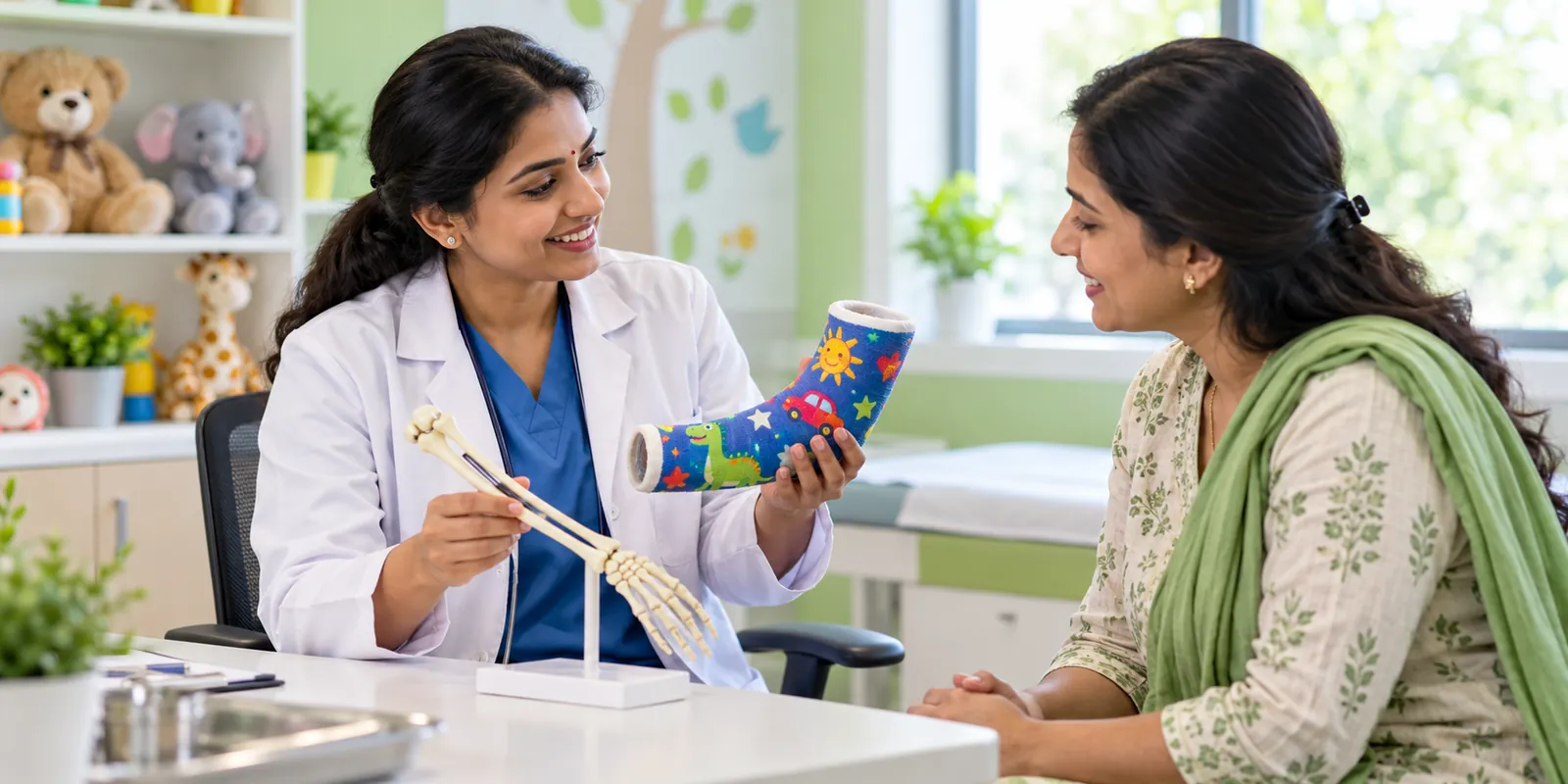
The emergency team gives pain relief and supports the limb. X-rays confirm the fracture and show its type. The orthopaedic doctor checks the nerves and blood supply and explains the plan to you, in simple words for your child too.
Treatment
Casts and splints
Most children’s fractures heal well in a plaster or fibreglass cast or a splint. Buckle fractures of the wrist often need only a removable splint for a few weeks.
Setting the bone (closed reduction)
When the broken ends are out of position, the doctor gently sets the bone back into place under sedation or anaesthesia, then applies a cast. Children’s bones remodel as they grow, so some angulation is acceptable in young children, and the doctor will explain what is expected.
Surgery
A smaller number of fractures need fixation with wires, screws or plates, for example some elbow fractures, fractures through a joint, and fractures that cannot be held in a cast. The surgeon will explain why and what to expect.
Looking after the cast
- Keep it dry. Cover it with a plastic bag when bathing.
- Do not let your child put pens, sticks or other objects inside it.
- Keep the limb raised for the first few days to control swelling.
- Encourage your child to wiggle their fingers or toes.
Come back straight away if the fingers or toes turn pale, blue or cold, there is numbness or tingling, pain keeps getting worse, or the cast cracks, gets soaked or smells bad.
Follow-up and growth
Children usually need follow-up X-rays to check that the bone is healing in a good position. Fractures near the growth plates are watched over time, so any effect on growth is caught early. Most children are back to full activity within weeks of the cast coming off.
Preventing falls and fractures at home
- Use safety gates on stairs and window guards for young children.
- Make sure children wear helmets and wrist guards when cycling or skating.
- Supervise play on trampolines, swings and climbing frames.
- Make sure children get enough calcium, vitamin D and outdoor activity for strong bones.
After a minor fall: when to bring your child in
Many falls cause only a bruise. Watch your child for a few hours and bring them to the hospital if:
- They keep refusing to use the arm or walk on the leg
- Swelling increases, or the limb looks bent
- Pain does not settle with rest and simple pain relief
- They are unusually sleepy, vomit, or hit their head
- The injured part is pale, cold or numb
If you are unsure, have it checked. An X-ray is quick, and the emergency is open 24 hours.
Helping your child cope with a cast
- Explain in simple words that the cast is like a hard bandage that helps the bone mend.
- Let friends and family sign it or draw on it.
- Plan easy activities at home, such as drawing, reading and board games.
- Talk to the school about help with writing, bags and stairs if needed.
- Praise them for being brave at each follow-up visit.
Common questions from parents
Will the bone be weaker after it heals? No. In children, a healed fracture is usually as strong as the rest of the bone.
Is a slightly bent healed bone a problem? In young children, bones often straighten as they grow. The doctor will explain what to expect for your child’s age and fracture.
Can my child bathe or swim with a cast? Most casts must stay dry. Ask before any water activity, and keep swimming for after the cast comes off.
Related care
Older children and teenagers often hurt themselves playing sport; see sports injury treatment. For fractures in adults and accident injuries, see fracture and trauma care.
Why Cheema Medical Complex
- 24/7 emergency with X-ray on site.
- Orthopaedic care led by Dr. Gaurav Jain, MBBS, MS (Orthopaedics), FISM (Spain), whose work includes trauma care.
- Paediatrics department in the same hospital.
- Physiotherapy if your child needs help regaining movement after the cast.
- On Mohali Stadium Road, Phase 4, close to Chandigarh, Zirakpur and Kharar, and trusted by families since 1988.
Book a follow-up or get help now
For an injury now, come to the emergency and call 8054922340 on the way. For a fracture review or follow-up, book an appointment. The orthopaedic OPD runs Monday to Saturday, 10:30 am to 5:00 pm.