



Fracture and trauma care at Cheema Medical Complex, Mohali
A broken bone or a road accident never comes at a convenient time. The emergency at Cheema Medical Complex (CMC Hospital) is open 24 hours a day, 7 days a week, on Mohali Stadium Road near the BSNL Telephone Exchange, Phase 4, Sector 59. X-ray, CT scan, the lab, the pharmacy, the operation theatre and the orthopaedic team are all in the same hospital, so you are assessed, scanned and treated without being sent elsewhere.
We treat fractures and injuries from road accidents, falls at home, workplace accidents and sports, for adults, the elderly and children. Patients reach us from across Mohali and from Chandigarh, Zirakpur, Kharar, Landran and the Tricity.
In an emergency, call 8054922340 on the way so the team is ready when you arrive.
Injuries we treat
- Arm and hand: wrist fractures, forearm fractures, elbow and upper arm fractures, finger and hand fractures
- Shoulder: collarbone fractures, shoulder fractures and dislocations
- Leg and foot: thigh bone (femur) and shin bone (tibia) fractures, kneecap fractures, ankle fractures, foot fractures
- Hip and pelvis: hip fractures in older people, pelvis fractures after high-energy accidents
- Spine: fractures of the back after falls or accidents, including fragility fractures in osteoporosis
- Joint dislocations: shoulder, elbow, finger, kneecap and hip
- Children’s fractures, including fractures near the growth plates
- Ligament and tendon injuries that come with fractures
What happens when you arrive
- Triage and first aid. The emergency team checks breathing, circulation and bleeding first, then pain relief and splinting of the injured limb.
- Imaging. X-rays for most fractures; a CT scan when the break is complex, goes into a joint, or involves the spine or pelvis.
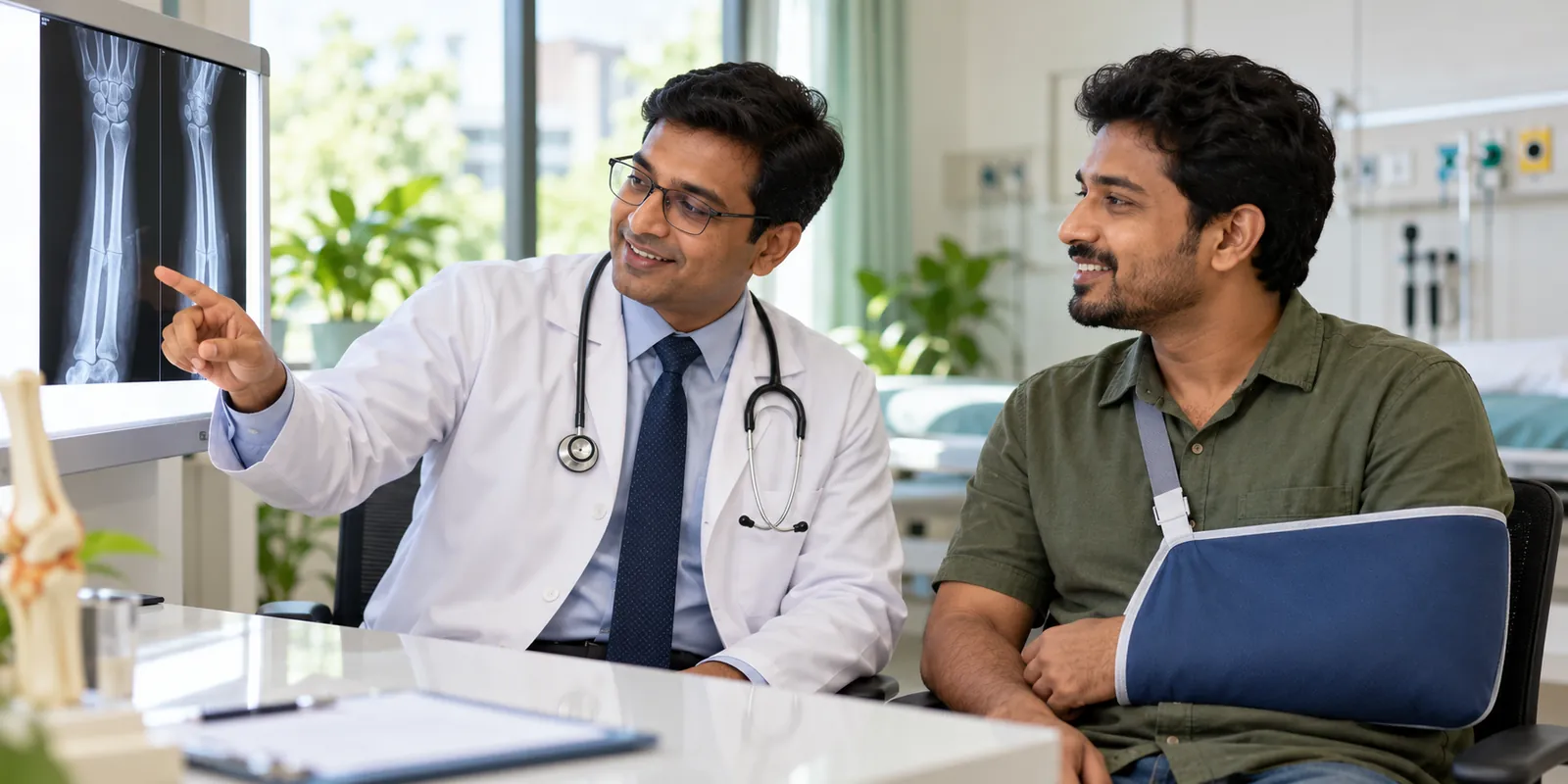
- Orthopaedic assessment. The orthopaedic doctor reviews the images and examines the limb, nerves and blood supply.
- A clear plan. You are told whether the fracture can be treated in a cast or splint, or needs a procedure or surgery, and what happens next.
For patients with other injuries, such as head or abdominal injuries, the multispeciality team in the hospital is involved as needed.
Treatment without surgery
Many fractures heal well without an operation:
- Plaster casts and fibreglass casts to hold the bone while it heals
- Splints, slabs and braces, especially when swelling is expected
- Closed reduction, where the doctor gently sets a displaced bone back into place under anaesthesia or sedation, then applies a cast
- Slings for collarbone and some shoulder fractures
You will be told how to look after your cast, which warning signs to watch for (such as severe pain, numbness, or blue or very swollen fingers or toes), and when to come back for a check X-ray.
Fracture surgery
Surgery is needed when a cast cannot hold the bone in the right position, or when the joint surface is involved. The common methods are:
- Plates and screws fixed to the outside of the bone, often for fractures near joints
- Intramedullary nails: a rod passed down the middle of a long bone such as the femur or tibia
- Screws and wires for smaller bones and some joint fractures
- External fixators: a frame outside the limb, used for some open or severe fractures
- Joint replacement for certain hip fractures in older patients; see hip replacement surgery
The goal is to put the bone back in its proper shape, hold it firmly and get you moving as early as is safe.
Common fractures and how they are usually treated
Every fracture is different, and the final plan depends on the X-ray, your age and your work. This table shows the usual starting point for some common injuries.
| Injury | Usual first treatment | When surgery is more likely |
|---|---|---|
| Wrist fracture after a fall | Setting the bone if needed, then a cast for around six weeks | The break goes into the joint or slips in the cast |
| Collarbone fracture | A sling and pain relief | The ends overlap a lot or press on the skin |
| Ankle fracture | A cast or boot for stable breaks | The ankle joint is out of line |
| Shin bone (tibia) fracture | A long cast for some stable breaks | Most displaced breaks, usually with a nail |
| Thigh bone (femur) fracture | Hospital admission | Almost always, usually with a nail or plate |
| Hip fracture in older people | Hospital admission and pain relief | Almost always, with screws, a nail or a hip replacement |
| Finger and hand fractures | Splint or buddy strapping | Rotated fingers or joint fractures |
Signs that need a quick return to the hospital
If you are in a cast or have had fracture surgery, come back to the emergency straight away if you notice:
- Pain that keeps getting worse instead of better
- Numbness, tingling, or fingers or toes that turn pale, blue or cold
- A cast that feels too tight, or swelling that will not go down with the limb raised
- Fever, or redness, discharge or a bad smell from the wound
- Sudden calf pain, chest pain or breathlessness
Open fractures and serious accident injuries
When a broken bone has come through the skin, infection is the biggest risk. These injuries need urgent cleaning of the wound in the operation theatre, antibiotics and stabilisation of the bone, sometimes in stages. Come straight to the emergency and do not try to push the bone back.
Hip fractures in elderly patients
A fall that breaks the hip is common in older people, especially women with weak bones. Early surgery and getting the patient out of bed soon afterwards lowers the risk of chest infection, clots and bedsores, and gives the best chance of walking again. The hospital’s physicians help manage blood pressure, diabetes and heart conditions around the operation.
After a fragility fracture, ask about testing and treatment for osteoporosis, which lowers the risk of another fracture.
Recovery and physiotherapy
Bone usually takes six weeks to three months or more to heal, depending on the bone and the patient. During this time:
- Keep follow-up appointments for check X-rays.
- Keep the limb raised in the first days to control swelling.
- Move the joints that are free, as advised, to prevent stiffness.
- Start physiotherapy at the right time to rebuild strength, movement and walking. Physiotherapy is available in the same hospital.
- Avoid smoking, and keep blood sugar under control, as both slow bone healing.
Children’s fractures
Children’s bones are softer and heal faster than adults’ bones. Many children’s fractures are treated with a cast for a few weeks. Fractures near the growth plates are checked carefully over time so the bone keeps growing straight.
Sports injuries
Not every sports injury is a fracture. Twisting injuries of the knee and shoulder often damage ligaments and cartilage instead. If an X-ray is normal but the joint is swollen or unstable, read about arthroscopy and ACL surgery.
Why Cheema Medical Complex for trauma
- 24/7 emergency on Mohali Stadium Road, Phase 4.
- X-ray, CT scan, lab and pharmacy in the same building.
- Orthopaedic surgeon for fractures and trauma: Dr. Gaurav Jain, MBBS, MS (Orthopaedics), FISM (Spain).
- Multispeciality support for patients with other injuries or medical conditions.
- Physiotherapy for recovery after the cast or surgery.
- Serving Mohali and the Tricity since 1988.
Need help now?
For an emergency, come straight to the hospital and call 8054922340 on the way. For a non-urgent fracture review or a follow-up, book an appointment. The orthopaedic OPD runs Monday to Saturday, 10:30 am to 5:00 pm.